
As a part of the SBI Fellowship programme, youngsters aged between 21 and 32 years get to work with NGOs on several projects in rural India.

The Supreme Court has deferred the hearing on a PIL alleging large-scale banking fraud involving the Anil Dhirubhai Ambani Group and its firms to May 8.

Gurugram police have arrested a wanted accused linked to several ATM thefts amounting to lakhs of rupees. The accused, Aashiq, is a proclaimed offender and has multiple cases registered against him.

Indian stock market indices Sensex and Nifty experienced a decline in early trade due to surging crude oil prices and ongoing geopolitical uncertainty in West Asia. Foreign fund outflows further contributed to the negative sentiment.

States will remain "net gainers" of the proposed GST rate rationalisation exercise with their GST revenues, including devolution, estimated to be over Rs 14.10 lakh crore this fiscal, according to an SBI Research report released on Tuesday. It said that, as was evidenced in the earlier exercise of GST rate rationalisation in 2018 and 2019, an immediate reduction in rates can cause a short-term dip of around 3-4 per cent in month-on-month collections (roughly Rs 5,000 crore, or an annualised Rs 60,000 crore), revenues typically rebound with sustained growth of 5-6 per cent per month.

One 97 Communications Ltd, operating under the Paytm brand, has transitioned to a majority Indian-owned and controlled company, reflecting increased domestic investor confidence and improved financial performance.

India Inc, which is sitting on cash balances of 13.5 trillion, is using the funds to meet capital expenditure as well as brownfield expansion, resulting in 'anaemic' demand for bank loans, State Bank of India (SBI) chairman CS Setty said at an event on Monday. He added that a slowdown in corporate credit is mainly due to lack of demand.

rediffGURU Jinal Mehta answers readers' financial planning and health insurance queries

The BSE Sensex and the Nifty 50 declined around 4.5 per cent each since the start of the West Asia conflict.

Police in Shillong arrested 16 people during a crackdown on prostitution activities following complaints from citizens and local stakeholders.

India's market landscape is undergoing significant shifts, with bank-backed brokerages potentially regaining dominance over discount platforms due to regulatory changes and increased taxes, while the IPO pipeline faces a slowdown amid heightened global volatility.
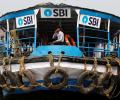
State Bank of India (SBI), India's largest lender, reported an impressive 84% jump in its standalone net profit for the December quarter, reaching Rs 16,891 crore. This is a significant increase from the Rs 9,164 crore earned in the same period last year. The bank's total income also grew to Rs 1,28,467 crore in Q3 FY24, compared to Rs 1,18,193 crore in the same period a year ago. SBI's asset quality improved as well, with gross NPAs declining to 2.07% at the end of December from 2.42% a year ago. Net NPAs also eased to 0.53% from 0.64% in the same period last year. On a consolidated basis, SBI Group's net profit rose by 70% to Rs 18,853 crore in Q3 FY24.

Indian equities on Dalal Street saw volatility as global market trends and fresh tariff concerns linked to Donald Trump impacted investor sentiment. Track Sensex, Nifty50 movement and key market drivers for April 2, 2026.

The Reserve Bank of India's (RBI) cap on banks' forex positions provided only a temporary boost to the rupee, with the currency quickly reversing gains and breaching the 95-per-dollar mark due to persistent underlying pressures.

Indian markets on Dalal Street rallied sharply as easing tensions in the US-Iran conflict and stable oil prices boosted sentiment. Track Nifty 50 and BSE Sensex performance and key global triggers.
Indian equities on Dalal Street saw volatility as global market trends and fresh tariff concerns linked to Donald Trump impacted investor sentiment. Track Sensex, Nifty50 movement and key market drivers for March 30, 2026.

Indian stock markets tumbled sharply with the Sensex falling 800 points and nearly 4 lakh crore wiped out in a single session. Here are the 6 key factors, including rupee weakness and global cues, behind the crash.

Indian equities on Dalal Street saw volatility. Track Sensex, Nifty50 movement and key market drivers for Feb 25, 2026.

The Rajasthan High Court has granted bail to two accused in an ATM theft case, ordering them to plant trees as community service, emphasising a reformative approach to criminal justice.

The Central Information Commission (CIC) has directed the Income Tax Department to disclose 'generic details of the net taxable income/gross income' of an estranged husband to his wife for pursuing maintenance proceedings. The commission stated that such information cannot be denied on privacy grounds in matrimonial disputes.

If you are interested in purchasing a POCO X8 Pro you are in luck...

The Indian IPO market is experiencing a significant surge in preliminary filings, with 38 companies submitting papers to SEBI in March 2026, driven by a combination of improved issuer confidence, strategic regulatory compliance, and private equity investors seeking exits amidst volatile market conditions.

Ask rediffGURU and tax expert Mihir Tanna your income tax-related questions

Indian markets on Dalal Street rallied sharply as easing tensions in the US-Iran conflict and stable oil prices boosted sentiment. Track Nifty 50 and BSE Sensex performance and key global triggers.

India's largest PSU bank, State Bank of India, delivered excellent results, once the impact of a big jump in employee expenses was adjusted for. The net interest income (NII) beat the Street due to a better net interest margin (NIM) and good loan growth. The credit growth at 5.2 per cent quarter-on-quarter (Q-o-Q) (15 per cent year on year) was excellent for a large bank.

Indian stock market benchmark indices Sensex and Nifty experienced a significant drop in early trade due to rising crude oil prices, bearish global market trends, and continuous foreign fund outflows.

Public sector banks' (PSBs') employee count grew for the first time in five years while private sector banks' staff strength saw a decline in 2024-25 (FY25), according to latest data released by the Reserve Bank of India (RBI). The employee count of state-owned lenders rose 0.22 per cent year-on-year (Y-o-Y) to 757,641 at the end of March 31, 2025 from 756,015 in FY24.

The State Bank of India (SBI), in its research, has estimated GDP growth during the current financial year (2024-25) to be 6.3 per cent, assuming that the NSO does not make major revisions to the erstwhile first and second quarter estimates.

Delhi Police have arrested three members of a robbery gang who posed as government officials to cheat and rob unsuspecting passengers near the New Delhi railway station.

Ask rediffGURU Reetika Sharma your insurance, mutual fund and personal finance-related questions.

After the State Bank of India, Bank of India has classified the loan account of insolvent Reliance Communications as fraudulent and named its former director, tycoon Anil Ambani, citing alleged fund diversion in 2016, according to a regulatory filing. State-owned Bank of India granted a Rs 700 crore loan in August 2016 to Reliance Communications for its ongoing capital and operational expenditure and repayment of existing liabilities.

Indian stock market benchmark indices Sensex and Nifty experienced a significant decline, driven by escalating tensions in the Middle East and rising crude oil prices.
Indian equity markets experienced a significant downturn, with the Sensex and Nifty plummeting due to rising crude oil prices, geopolitical tensions in West Asia, and continuous foreign fund outflows.

At a time when banks are finding it challenging to mobilise resources, State Bank of India (SBI)-the country's largest lender-has devised a three-pronged strategy to boost deposit accretion. First is an aspirational product that promises to make depositors lakhpatis by helping them grow their deposits to Rs 1 lakh through recurring deposit (RD) schemes.

Lalit Modi posted a social media video from Vijay Mallya's 70th birthday party in London, referring to the pair as the 'two biggest fugitives' of India.
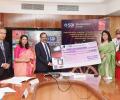
'You will see him frequently asking customers -- especially retail -- about service experience, pain points, areas of improvement and suggestions.'

'Statutory power must be exercised in a manner that is fair, proportionate, and not excessive.' 'The authority must demonstrate a rational nexus between the property frozen and the alleged offence.'

The Supreme Court has ordered a 'fair, dispassionate, transparent, and time-bound' investigation by the CBI and ED into the Anil Dhirubhai Ambani Group, addressing concerns over alleged large-scale banking fraud and demanding accountability.
It is to be seen if SBI under Setty, who will have a three-year term, can ride the economic cycle to take SBI to new heights, navigating some of these challenges.

'The FSIB will conduct interviews for the SBI chairman position on May 21-22 as the tenure of the current chairman Dinesh Kumar Khara is scheduled to end by August.'
